TL;DR: The viral “RNC crashed Grindr” claim doesn’t hold up under scrutiny. Grindr reported no outage. The “spike” came from Downdetector, a self-report tool anyone can submit to. There is a real, older signal underneath all of this (Grindr usage genuinely rises around big conventions), but the available data cannot support the conclusions people are drawing. This is a story about how a screenshot beats a fact to the finish line.
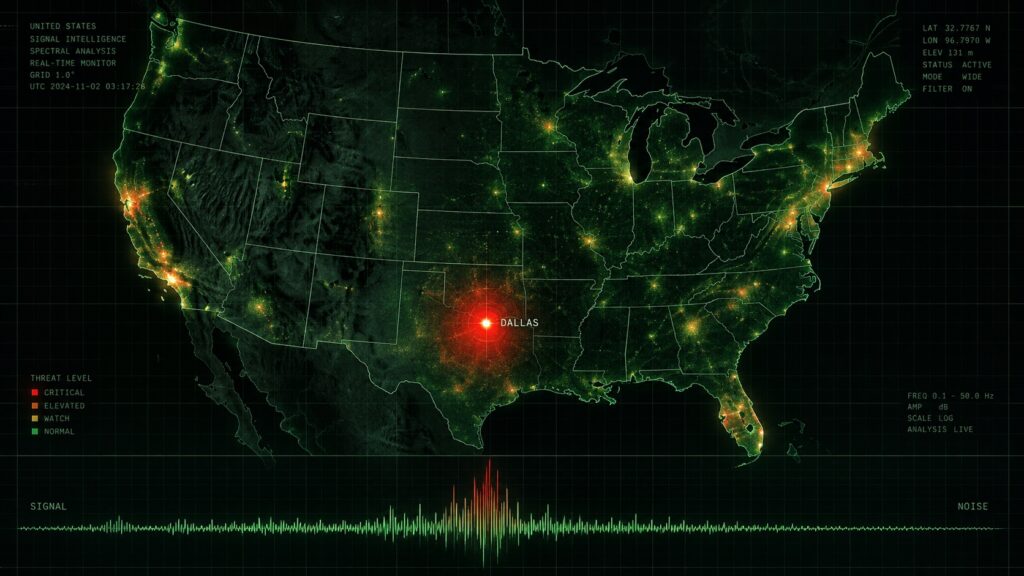
On the evening of September 9, 2026, the Republican National Convention’s first-ever midterm convention kicked off at American Airlines Center in Dallas. The GOP gathering had barely started when a Downdetector screenshot started making rounds on X. The graph showed a sharp spike in Grindr outage reports. Dallas was a bright spot on the heatmap.
The internet erupted with undisguised satisfaction. Social media users piled on. Political commentators, meme accounts, and even George Santos amplified the story. The narrative wrote itself: the party of family values, the party that has opposed same-sex marriage in successive platforms, was apparently crashing the world’s largest gay hookup and dating app as its members filed into the convention hall.
That’s enticing. It’s shareable. It’s the kind of ironic reversal that lights up social media faster than any correction can chase it.
But what does a sober analysis actually show? Did Grindr crash during the RNC, or did a screenshot just outrun the facts? What can we reasonably conclude from the available signals, and what is just noise dressed up as data?
Every Grindr crash RNC fact check published so far touches pieces of this story. None of them fully develops the three distinctions that actually matter.
The Claim vs. What’s Verifiable
The honest verdict here is not “nothing happened.” It’s that the viral story combines one possibly real signal with three conclusions the evidence cannot support.
| Claim | Supported? | Why |
|---|---|---|
| Downdetector reports spiked | Yes | Snopes confirmed a national peak of roughly 460 reports around 8:49 PM on September 9 |
| Grindr suffered a confirmed outage | No | Grindr’s status page showed no incident; the company denied any convention-related outage |
| RNC traffic caused the spike | Unproven | No causal link established in any reporting |
| The users were closeted anti-gay delegates | No evidence whatsoever | Location data does not reveal identity, affiliation, or beliefs |
That table is the core of this analysis. Everything below is context.
How Downdetector Actually Works
The mechanism matters. Downdetector collects user-submitted reports and monitors social media for mentions of service problems. It compares incoming reports against a six-month rolling baseline for each service. When reports exceed that baseline by a significant margin, Downdetector flags a possible incident.
That’s it. Downdetector is an early-warning system. It does not diagnose server failures. It does not access a company’s servers or backend infrastructure. It does not verify that submitters are experiencing genuine technical problems.
The Baseline Problem
Lead Stories found that Grindr’s normal Downdetector baseline sits between zero and one report. Think about what that means for a moment.
A rise from one report to 101 is a 10,000 percent increase. It looks catastrophic on a chart. In raw numbers, it’s 100 people clicking a button on a website. The Snopes-confirmed peak of 460 is notable, but it’s also a national number across all U.S. Downdetector submissions for Grindr that evening. Dallas appeared prominently on the heatmap, but the count was never a headcount of Dallas users. It was the total from every reporting city on the map.
That distinction is missing from most of the coverage.
The Feedback Loop
Once the joke starts trending, a self-reinforcing cycle kicks in:
- People open Grindr to check if it’s “really down”
- More people visit Downdetector
- Some file reports (genuine or otherwise)
- The graph grows
- The bigger graph generates more social media posts
- More people check Grindr and Downdetector
This is a textbook observation-feedback loop. No coordinated operation required. The measurement gets contaminated by the attention the claim itself generates. Snopes found that Downdetector comments during the period included references to the RNC with phrases like “Convention in Dallas, as always,” with no indication those comments came from people actually experiencing connection problems.
What Grindr Says Happened in Dallas
Grindr’s operational status page recorded no incident on September 9 or 10, 2026.
In a September 10, 2026 email to Lead Stories, a Grindr spokesperson stated:
While these rumors are common, the claim is false. Grindr has not experienced outages connected to the Republican National Conventions or other large events. Third party sources that often make these claims rely on unreliable data such as self-reporting, while Grindr reports outages directly on its status page.
The company’s most recent recorded outage before Dallas was July 22, 2026.
A Fair Caveat
A status page is maintained by the company being evaluated. It could miss a brief, geographically limited, or carrier-specific problem. A handful of users experiencing failures would not necessarily trigger a declared company incident. That’s standard practice in platform operations.
The responsible conclusion: Grindr’s telemetry and public status reporting weigh strongly against a platform-wide crash. They cannot prove that no individual user experienced a problem. But “some people may have had app issues” is a very different claim than “the RNC crashed Grindr.”
Cleveland 2016: The One Piece of Hard Data
The 2016 RNC produced the most detailed figures directly attributed to Grindr’s own data. These numbers were reported by VICE and came from the company itself.
Within five miles of Cleveland’s Quicken Loans Arena during the convention:
- Grindr usage rose 120 percent on check-in Sunday
- Usage was 66 percent higher across the full RNC period
- Over 1,000 Grindr users appeared near the arena
- 44 percent were classified as visitors to Cleveland
- 75 percent of those visitors were white
- “Visiting” and “fun” were common profile keywords
- 27 profiles mentioned the RNC
- 6 mentioned Trump
This is real, sourced data worth taking seriously. The convention almost certainly contributed to increased local Grindr activity. At least some users were probably connected to the broader RNC ecosystem.
But here’s where the analytical discipline matters. That data measures presence near a location. It does not measure identity. It does not measure political affiliation. It does not measure whether someone is closeted or openly gay.
Why the “5 Percent of RNC Attendees” Math Fails
This is one of the biggest analytical errors in the coverage, and none of the existing fact-checks fully develop it.
VICE divided “more than 1,000” Grindr users near the Cleveland arena by an estimated 20,000 convention attendees. The result: roughly 5 percent of RNC attendees used Grindr. The math looks clean. The conclusion is invalid.
Here’s why. Those two populations are not interchangeable.
The numerator (1,000+ Grindr users) included everyone using the app within a five-mile radius. That captured:
- Cleveland residents going about their lives
- Hotel employees
- Restaurant and bar patrons
- Journalists and media crews
- Police and security personnel
- Protesters and activists
- Nonpolitical visitors and tourists
- People passing through the area
The denominator (20,000 attendees) counted only convention participants.
You’re dividing a geographic headcount by a group-specific headcount. The populations overlap, but they are not the same set. This is a denominator error compounded by an ecological fallacy: inferring something about individuals (they’re Republican delegates) from aggregate geographic data (they were near the arena).
The DNC Comparison That Changes the Story
During the 2016 Democratic National Convention, Grindr activity near Philadelphia’s Wells Fargo Center increased 148 percent from Sunday to Monday. That’s a bigger spike than Cleveland’s 66 percent.
The time windows were not identical, so this is not a perfectly controlled comparison. But it demonstrates an important point: increased Grindr activity was not unique to Republican conventions. If a Democratic convention produces an even larger increase, the general mechanism starts to look like travel, density, and convention nightlife rather than specifically Republican hypocrisy.
CPAC Confirms the Pattern
Tinder usage at the 2016 Conservative Political Action Conference reportedly rose 230 percent compared with the prior weekend, with matches increasing roughly 1,700 percent. This is heterosexual and mixed-orientation dating activity surging at a political gathering. Concentrate thousands of traveling adults in hotels, receptions, and after-parties, and dating-app usage rises. That pattern holds across parties, across orientations, and across apps.
This does not rule out gay Republican hookups. It does show that a spike in romantic or sexual activity at a political convention is not, by itself, evidence of mass closeted hypocrisy.
Milwaukee 2024: Usage Spike, Not a Crash
The narrative that Grindr crashes during RNC events picked up real momentum after Milwaukee. Grindr CEO George Arison addressed the 2024 Republican National Convention in Milwaukee directly in a 2025 interview. His statement was notable for how precisely it drew the line:
The convention saw a “definite” and “significant” rise in usage. Grindr “didn’t actually crash.” The platform’s audience is politically diverse.
Downdetector showed over 1,000 reports during that convention, with reports also noted in Chicago, Los Angeles, and New York. Grindr’s status tracker showed services as operational. The Milwaukee Journal-Sentinel confirmed this at the time.
That CEO statement is the cleanest available distinction between activity and availability. Usage went up. The platform stayed up. Two very different things.
The Three Populations Nobody Separates
This is where most coverage collapses. The viral narrative treats three completely different groups as if they are the same population:
- People who filed Downdetector reports. This group self-selected. Anyone can submit a report. Submissions are unvetted. Some may have been genuine. Some may have been jokes. Some may have been politically motivated.
- People actually using Grindr near the convention venue. This is a different, larger group. Most of them never filed a Downdetector report. They include locals, journalists, security, travelers, and yes, possibly some attendees.
- Closeted anti-gay Republican delegates. This is the group the viral story claims to have identified. No data source available, including Downdetector reports, Grindr location data, or social media screenshots, can distinguish this group from the other two.
Claims about group three are being built entirely from data about groups one and two. That is the core problem with the entire narrative.
Who Could Actually Be on Grindr Near an RNC?
If we’re being rigorous about the potential population within range of a convention venue, the list is longer than the joke assumes:
- Openly gay Republicans (yes, they exist)
- Closeted attendees (also plausible)
- Bisexual attendees
- Local residents
- Journalists and content creators
- Protesters and opposition researchers
- Convention employees, vendors, and contractors
- Police and private security
- Business travelers and tourists
- People checking the app because the Grindr story was trending
- Users exploring from other locations via Grindr’s map feature
The first category alone breaks the equation. A person can be openly gay, politically conservative, and attending the convention without being closeted or hypocritical. Political complexity cannot be inferred from app activity.
This Has Happened Before: The Information Operations Playbook
The Grindr-RNC cycle follows a pattern that anyone in SEO, OSINT, or digital intelligence should recognize. The tools change. The mechanism stays the same.
The “Miserable Failure” Google Bomb (2003)
In October 2003, blogger George Johnston launched a coordinated campaign asking people to link the phrase “miserable failure” to President George W. Bush’s official White House biography. Within weeks, Bush’s bio was the #1 result for that phrase on Google. The campaign exploited PageRank’s reliance on anchor text. A determined group gamed an open input (backlinks), generated a visible result (a #1 ranking), and the screenshot traveled.
Google didn’t fix the algorithm to defuse these kinds of bombs until January 2007. Four years of a manufactured search result presented as organic.
The Santorum Campaign (2003)
Sex columnist Dan Savage launched a campaign to redefine then-Senator Rick Santorum’s name as a graphic sexual neologism, creating spreadingsantorum.com to promote the definition. The site ranked above Santorum’s own campaign website for years. Same playbook: exploit an open input (search rankings), generate a persistent visible artifact, let the output travel.
The Grindr-RNC Pattern
Downdetector is a different kind of system than PageRank. It doesn’t rank pages. It aggregates self-reports. But the vulnerability is structurally identical: it’s an open input anyone can submit to, and it produces a visual output (a chart, a heatmap) that screenshots well and circulates faster than any correction.
The information chain in Dallas looked like this:
- Someone posts a Downdetector screenshot showing a spike
- Political commentators and meme accounts amplify it
- “People are reporting problems” becomes “Grindr is down”
- “Grindr is down during the RNC” becomes “the RNC crashed Grindr”
- That becomes “closeted anti-gay Republicans overwhelmed the app”
- News outlets and Jimmy Kimmel repeat versions of the completed narrative
Every step adds a claim that the original data did not contain. That is how noise gets laundered into a signal.
Key distinction to be honest about: Google bombing gamed a deterministic algorithm. Downdetector is a self-report tool that never measured server health to begin with. Different mechanism, same information-operations shape.
The Data Is Not Airtight, but Grade It on a Curve
Here’s a point that would be dishonest to skip. The underlying Downdetector and Grindr location data from these conventions is not airtight. Nobody disputes that. But compared to the usual standard of inference-passing-as-data in political and social media discourse, it’s par for the course if not a B+ by comparison.
Most viral claims don’t come with timestamped third-party reporting tools, a company denial on the record, a CEO confirming part of the story while denying another part, and a decade of comparable events across both parties. There’s actually a fair amount of data here. The problem isn’t the data. The problem is the gap between what the data shows and what the narrative claims.
The signal: usage probably did increase in Dallas during the convention, as it has at previous conventions across both parties.
The noise: the outage claim, the causation claim, and the identity claim. Those three are unsupported.
Does This Mean No Hypocrites Exist?
No.
This section exists because a good debunk can’t become its own dishonest counter-narrative.
There are documented cases of conservative politicians whose private same-sex behavior directly contradicted their public positions on LGBTQ rights. Social and religious conservatism can make coming out more difficult for gay men and women, and that pressure is real. It is entirely plausible that some attendees at any large political gathering are privately seeking connections they would not acknowledge publicly.
But “some probably did” is a different claim from “they crashed Grindr.” A general pattern or a reasonable suspicion cannot identify the people behind anonymous, aggregate data. The story works as a cultural observation. It fails as a factual claim.
What Evidence Would Actually Prove the Claim?
A credible investigation would require:
- Grindr’s internal unique-user and session data for a defined Dallas geofence
- Server error rates, latency, and failed-request telemetry during the alleged outage window
- Comparable data from matched weekdays before and after the convention
- Dallas-specific reports separated from the national Downdetector count
- Cellular-carrier performance data near American Airlines Center
- Visitor-versus-local user classifications
- Matched comparisons with the DNC and similarly sized non-political conventions
- Some form of opt-in survey establishing actual convention attendance
Nobody has produced any of this. Until someone does, the narrative rests on a Downdetector screenshot and a cultural stereotype.
What We Can Actually Say
So did the RNC cause a Grindr crash? Here’s the claim-by-claim breakdown:
| Question | Answer |
|---|---|
| Did Grindr receive an unusual number of Downdetector reports? | Yes |
| Was Dallas prominent on the heatmap? | Yes |
| Did Grindr confirm an outage? | No |
| Did the RNC crash Grindr? | Not supported and probably false |
| Has Grindr usage increased around past conventions? | Yes, confirmed for 2016 Cleveland and 2024 Milwaukee |
| Were some convention-associated people likely using the app? | Plausible and likely |
| Does the data prove mass closeted Republican hypocrisy? | No |
| Could individual hypocrites have been among the users? | Certainly possible, but not measurable from available data |
The story works perfectly as a joke because it confirms what its audience already believes. As a factual claim, “the RNC crashed Grindr” requires three things: an outage, a cause, and identifiable users. The available evidence provides none of the three.
What it does provide is a useful case study in how open-input systems get gamed, how screenshots outrun corrections, and how the gap between a signal and its interpretation is where most misinformation lives. That gap is the whole story.